

Resources
She made it easier for me to come back
Have you ever talked yourself out of going somewhere new?
Many of us will know the familiar feeling of uncertainty when we’re about to try something new. The swirl in our tummy, the fuzzy thoughts racing through our mind, the sweaty palms, the big deep breath before we enter the room, the fear of awkward conversation, or not knowing anyone… it’s something we all feel in different ways; a collective symptom of being a social human being.
We often hear a shared sentiment like this from community members who are attending a new gathering in the Befriend Social Network;
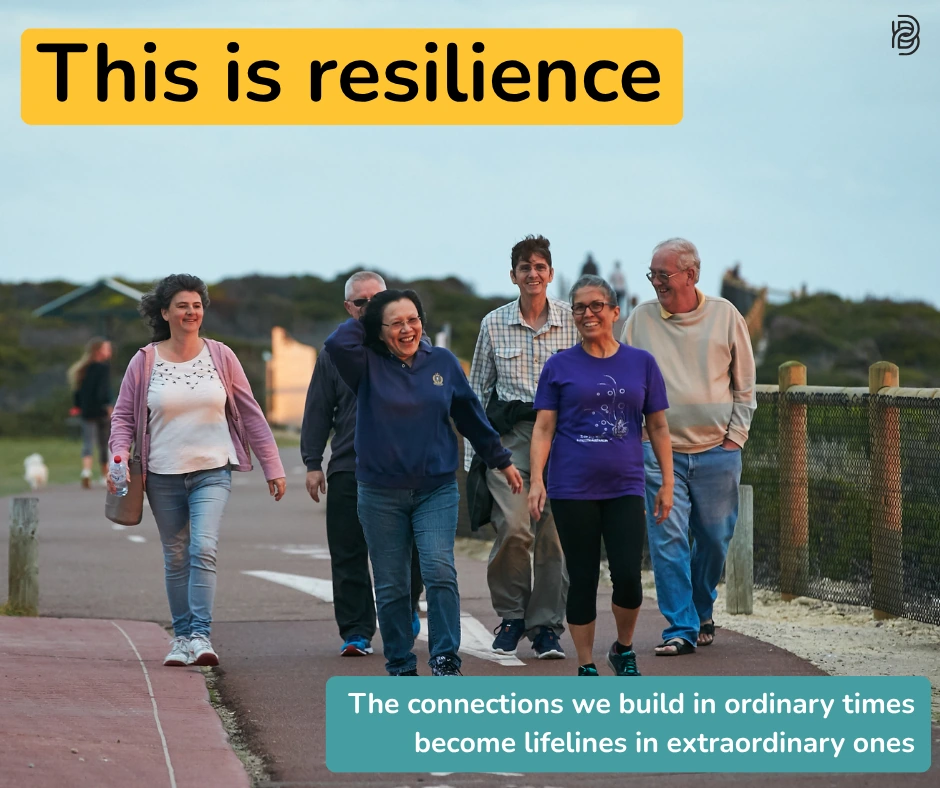
I was really nervous at first. But I needn’t have worried; I was welcomed in by everyone ~ Sacha, community member and Host of Walk and Talk in Armadale
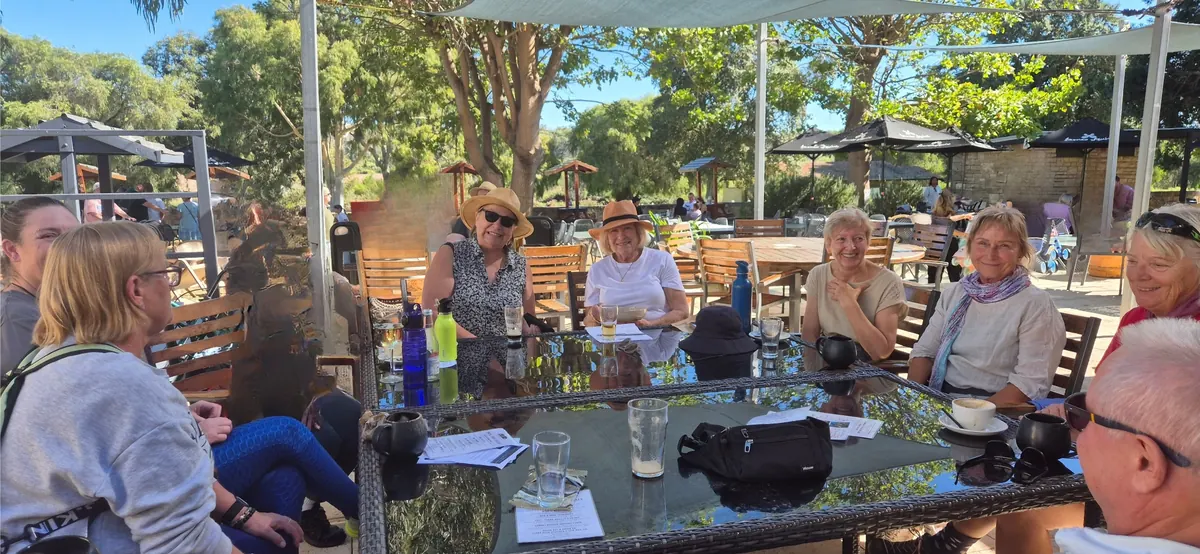
When we began to learn more about what the ‘welcome’ actually looks like and the difference it makes for people turning up for the first time, we find that the detail is often in the small gestures. It’s one or two people making it easier to show up again.
She made it easier for me to come back.
There’s something really powerful yet simple about these words as they remind us that the possibility of connection really begins when we feel welcome enough to keep coming back.
Small invitations can make a big difference
Over the course of a two-year project in partnership with the Department of Fire and Emergency Services, our community building team explored how everyday relationships help people navigate life’s challenges, and how these connections contribute to greater community resilience. Subsequently, we produced a report called Hidden Lifelines outlining our findings and the stories we gathered in greater detail.
One of the key things we learnt was that meaningful relationships often grow through small acts of invitation and inclusion, one small gesture at a time. Through listening to people’s stories of community life and spirit, we learned that ‘feeling welcomed’ can look like a lot of things:
- It’s the person who remembers your name
- The neighbour who stops for a chat
- The group member who saves you a seat, introduces you to someone new, helps you learn part of the activity, or checks whether you’ll be coming along next week
- The barista at the coffee shop who remembers the last conversation you had and asks a curious question
These moments might seem small, but they can help someone move from feeling like an outsider to feeling like they belong. And when we feel we belong, we’re much more likely to keep showing up. And when we show up, over time, familiar faces can become friends, and friends can become the very people we turn to when life gets difficult.
What does this have to do with resilience?
When we think about resilience, we might picture being “mentally tough”, having a big plan so we feel prepared, or having a flexible, rubber-like quality of being able to “bounce-back” that people sometimes refer to.
Maybe some of that is true. But what we’ve found through this work is that resilience is also found in the relationships we build long before anything goes wrong.
Getting through life’s unexpected difficulties, be that a bushfire, grief, poor health, the end of a relationship, moving home, financial strain, becoming a parent – is made significantly easier when we have people around. When we know there are people who will notice that we’re struggling, who will listen when we need to talk, who will offer us a lift when the car breaks down, who will keep us company whilst we recover from an operation.
These relationships don’t appear overnight. They’re nurtured through time, through everyday interactions, shared experiences and the small ways we make space for one another.
Every time we invite someone in, make them feel welcome or help them feel comfortable enough to return, we’re contributing to the possibility that that individual might form a meaningful connection, which in turn, might become someone they can rely on when they need it.
Embedded within all the communities we’re part of, we’re sowing seeds for resilience to grow, without necessarily calling it that.
Who could you make it easier for?
You don’t need to start a new group, become everyone’s best friend, or go too far out of your way to be a welcoming presence for someone. You can begin with the people and places already around you.
In chatting with community members from all walks of life about what resilience looks like for them, we heard about some really simple gestures that made a big difference for them.
Reducing barriers for people so everyone can be involved
The students suggested going out for coffee together, but some people could not afford that. They said, “Why don’t we just have coffee or tea here?” because the place where we meet has a kitchen. That meant everybody could participate and give input into making a community.
Help someone in your group learn something new
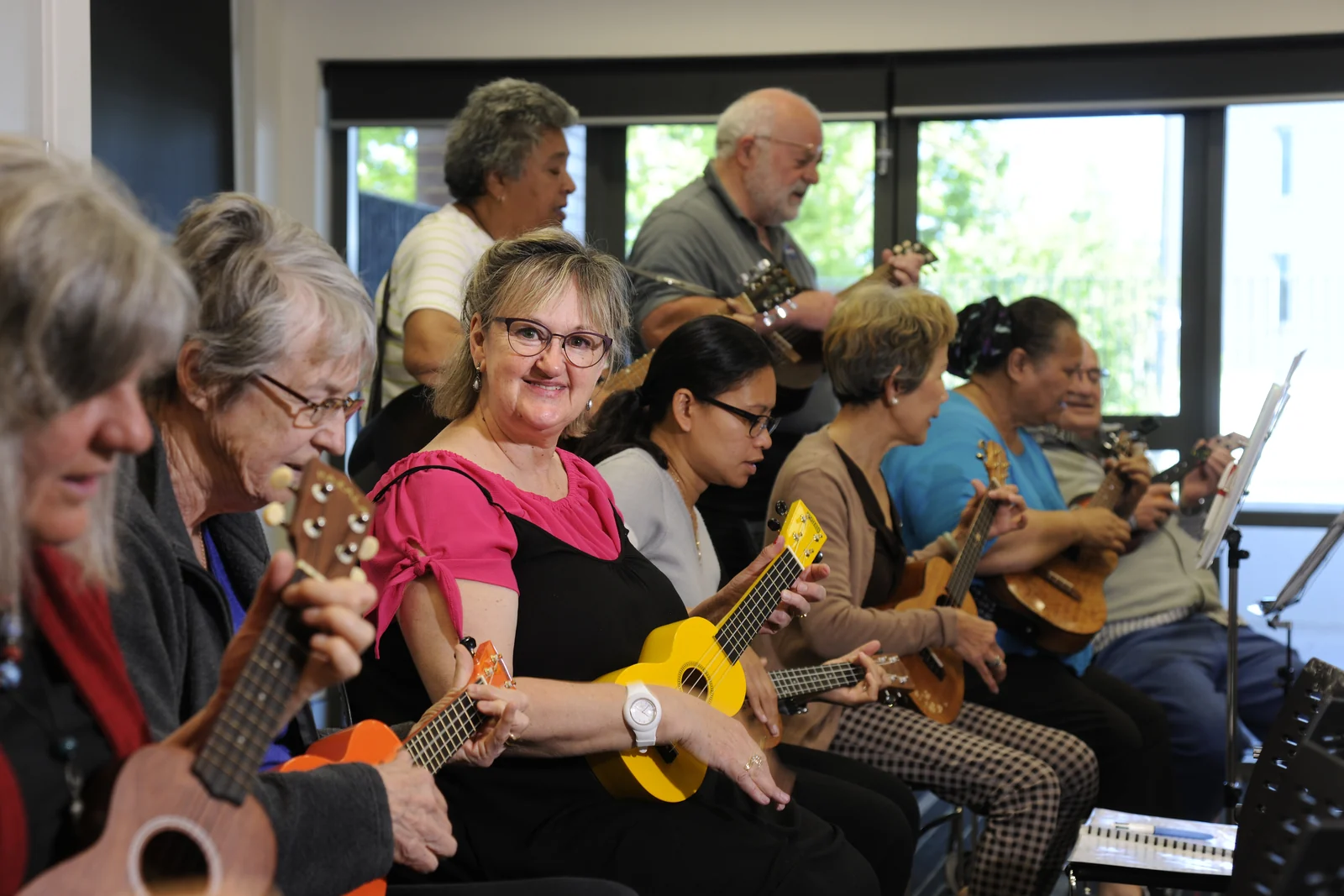
The first time I went to ukulele, I had never played and did not know anything. One of the women pulled me aside and showed me four notes. She made it easier for me to come back. It did not matter that I could not play yet. I could still belong.
Reach out to someone who hasn’t been around lately
Lylla stopped coming because she suffers from depression very bad. We visited her and invited her back.
Be curious about the little details
As soon as someone comes [to the window of the cafe we own], we ask, “How are you? How has your day been? What’s your name? Who are you?” That sort of thing. We want to get to know them in that short window when we see them. A big part of our approach is remembering the small details and names and making sure people feel seen
And if you’re the person who’s new, remember that coming back is an act of resilience, too. You don’t have to feel completely comfortable straight away, but, perhaps you need to trust in the idea that all friends start off as strangers who were brave enough to come back again and again.
Take a moment to think about your own village: the friends, neighbours, workmates, parents at school pick-up, local business owners and people in the groups you belong to.
Who helps you feel welcome?
Who might you check in on?
What’s something – one thing – you could do in your social group to help someone new find their way in?
We may never fully know the ripple effects of small, welcoming gestures, but, from our work across this project, we do know that when life gets hard, the people who help us through it are often the people we’ve been connecting with all along.
With thanks to the Department of Fire and Emergency Services for their support in bringing this project to life. Please note that some names have been changed to protect the privacy of community members who participated in the research.
Related articles
Looking after each other
When does a friendly face become someone you can count on? Community members share how practical help and being able…
View this resource
The art of giving and receiving
Are you always the helper? Mutual support means letting others care for you too. We explore why receiving help matters…
View this resource 
The power of a warm welcome
Walking into a new group can be nerve-racking. Community members told us how small gestures of welcome helped them come…
View this resource 
Little offers make a big difference
Good things often start with a small offer: a hand with something, an invitation, a skill shared. We look at…
View this resource 
What's the relationship between a craft group and a bushfire?
Friendship is often treated as a nice-to-have. In the first post of our This Is Resilience series, we look at…
View this resource 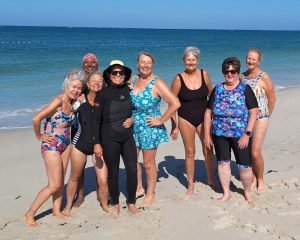
Merfolk Tales: More Than a Swim
What began as two friends meeting for a weekly swim has become a welcoming community. Through Merfolk Tales, women are…
View this resource 
Hidden Lifelines
What's the relationship between a craft group and a bushfire? A two-year Befriend project found the answer in friendship groups,…
View this resource 
Gift Discovery and deep listening: what happens when a team really listens to each other
Before a team of student consultants got stuck into their work for Befriend, Dave and Elaine gave them a taste…
View this resource 
Befriend wins the 2026 WA Inclusive Volunteering Award
We are absolutely over the moon to share that Befriend has been named the winner of the Inclusive Volunteering Award…
View this resource 
John's WingSpan Group
Each Friday morning at Armadale Library, the meeting room is transformed into a bird sanctuary. Tabletops become havens for birds…
View this resource 
Nat's Art Circle
Through Nat’s Art Circle, Nat offers a quiet, creative space for connection, where people can show up exactly as they…
View this resource 
2025 Social Impact Report
Befriend’s 2025 Social Impact Report captures how grassroots community building is strengthening connection, belonging, and wellbeing across Greater Perth. With…
View this resource 
Helping Others Feel More Connected
Supporting someone to feel more connected means creating the right conditions for friendships to grow. By focusing on shared interests,…
View this resource 
Ep 1. The Builder
Alyssa Nixon-Lloyd has always had a keen interest in community. Growing up in a small country town, community-building was second…
View this resource 
Ep 2. The Sociologist
2020 will always be known as the year we all jumped on online to socialise. But we had a question;…
View this resource 
Ep 3. The Researcher
We see a lot in the media about the downside of online connections and the superiority of face-to-face friendships. But…
View this resource 
Ep 4. The Dreamer
Valerie Weyland dreams big. In her early 20’s she moved by herself to Australia, a place where she knew no-one,…
View this resource 
Ep 5. The Optimist and the Listener
Fee has a happy knack of seeing the best in everyone. As a woman with an intellectual disability and autism,…
View this resource 
Ep 6. The Empowerer
In this episode, we talk with occupational therapist and disability rights advocate, Dr. Bec Waters. Bec teaches a unit about…
View this resource 
Ep 7. The Facilitator
Dave Lindner is Befriend’s Community Connector – he’s the guy who helps Befriend members create new communities and connections. In…
View this resource 
Give the gift of connection this Christmas!
Human connection is the best gift of all. We tend to think of the festive season as a busy time…
View this resource 
The Swan Repair Cafe
The Swan Repair Café is not just about mending broken items – it’s about people, community, and giving things a…
View this resource 
"I Like People!"
Tim’s story shows how connection grows through purpose, creativity, and contribution. Living with expressive aphasia and using a wheelchair, he…
View this resource 
Resilient Together Wanneroo Project
Befriend is building stronger, more resilient communities in Wanneroo and Perth’s northern corridor by nurturing local connections and community-led initiatives.…
View this resource 
Garry's Story
Garry is the one of the Hosts of the Burns Beach Sunset Walk and the Neil Hawkins BBQ, alongside his…
View this resource 
Cav Cafe - "setting the world right in our little way"
“I was sitting in the cafe in January with my husband and grandchildren, when I noticed a little Befriend postcard…
View this resource 
Nurturing your own community idea to life
Nurturing a new community idea to life can feel like stepping into the unknown – exciting and a little intimidating!
View this resource 
Sarah-Lee's story
Sarah Lee Parker is no stranger to bringing people together. “To tell you the truth, I’ve always been a community…
View this resource 
Robyn's story
With so much land development happening across greater Perth, we continue to see the development of new suburbs and new…
View this resource 
Alice's story
It’s been 9 years since Alice had to finish work, due to a combination of workplace changes and a personal…
View this resource Sandie's Story
Sandie Thorne has been a Host and a friend of Befriend for 6 years. After many months of juggling multiple…
View this resource 
The Possibility Fellowship Alumni - Journeying with Alysha
When Alysha dashed off stage to grab her guitar from hiding, and told us she had never before performed in…
View this resource 
The Possibility Fellowship Alumni - Journeying with Samantha
Samantha learned of the The Possibility Fellowship in late 2022 at a Ceremony for Befriend Volunteers in Wellard, where she…
View this resource 
The Possibility Fellowship Alumni - Journeying with Gonzalo
I always considered myself a curious person, ever since I was a child. It’s just that: how could one not…
View this resource 
The Possibility Fellowship Alumni - Journeying with Patricia
When Patricia left Colombia for Australia, she embarked on a journey far greater than the physical distance between these two…
View this resource 
The Possibility Fellowship Alumni - Journeying with Marika
Marika’s curiosity and love of play enticed her to come along to the taster session for the Possibility Fellowship 2023.…
View this resource 
The Possibility Fellowship Alumni - Journeying with Kim
It was in 2021 that Kim Hutchinson discovered her autistic identity, an important revelation in her ongoing quest for self-discovery,…
View this resource 
The Possibility Fellowship Alumni - Journeying with Barbara
Barbara began her community work as a 20-year-old at an Italian bakery in Brunswick Street, Fitzroy, an iconic district in…
View this resource 
Sue's Story
This is what I wrote during yet another lonely and frightening night of being unable to sleep, sitting in the…
View this resource 
The Possibility Fellowship Alumni - Journeying with Dianne
The event kept popping up on her phone screen. She thought of all the reasons why she shouldn’t participate—a 3-month…
View this resource 
Sharron's Story
Sharron’s journey is a testament to the resilience of the human spirit and the power of community. After a sudden…
View this resource 
The Empathy Effect: sparking friendships through the art of understanding each other!
Empathy is a powerful way to build connection and friendship, even with strangers. By showing curiosity, listening deeply, and keeping…
View this resource 
Give it a Go in Swan
Give it a Go is a fun, free travelling community adventure happening across different locations in the City of Swan!…
View this resource 
Open Communities - coming together in learning
Open Communities invites community builders, volunteers and organisations to co-design a shared learning space for connection and collaboration. Through gatherings,…
View this resource 
Feeling awkward about meeting new people? It's totally natural!
Do you often find yourself saying “I’d like to go… but I don’t really know anyone and it might be…
View this resource 
Margarita's Story
Margarita’s story is one we’ve loved to watch unfold: someone who stretched out of their comfort zone to spark connection…
View this resource 
Elizabeth's story
This is Elizabeth’s story, written by community dreamer, weaver, writer, story-teller and Befriend staff member, Nicola. It’s a story of…
View this resource 
Nicola's story
Meet Nicola. Nicola has been a Host with Befriend for a little over a year. But the journey that led…
View this resource 
Supporting Community: A Network Development Project in the City of Kwinana
We are a non-profit social enterprise based in Perth, Western Australia who exist for one single purpose; to foster inclusive,…
View this resource 
How do I make friends in Perth if I’m introverted?
You want to meet people, form friendships and feel less alone, but you think that your introverted nature is an…
View this resource 
Creating a friendship that lasts
Do you find that even if you chat with new people while out and about, these interactions don’t lead to…
View this resource Everyday connectors
COVID-19 was a strange time. It was a unique moment in history where we bunkered down safely at home wherever…
View this resource Want to keep up to date?
Be the first to hear about catch ups, seminars and other events by subscribing to our mailing list.
By submitting your information you agree to our Terms & Conditions and Privacy Policy.
By submitting your information you agree to our Terms & Conditions and Privacy Policy.