

Resources
Could making friends actually be one of the most significant things we could do to strengthen our resilience?
When we think about the value and importance of friendship in our lives, we might not immediately draw connections to significant disasters like bushfires. We’re probably more likely to think about friendship as a ‘nice-to-have,’ something that gives us people to hang out and chat with, something that gives us fun activities and events shared with others, something that gives us a light-hearted part of our life where we joke, laugh and play together. But thinking in this way, could we be underestimating and undervaluing one of the greatest assets of the human experience?
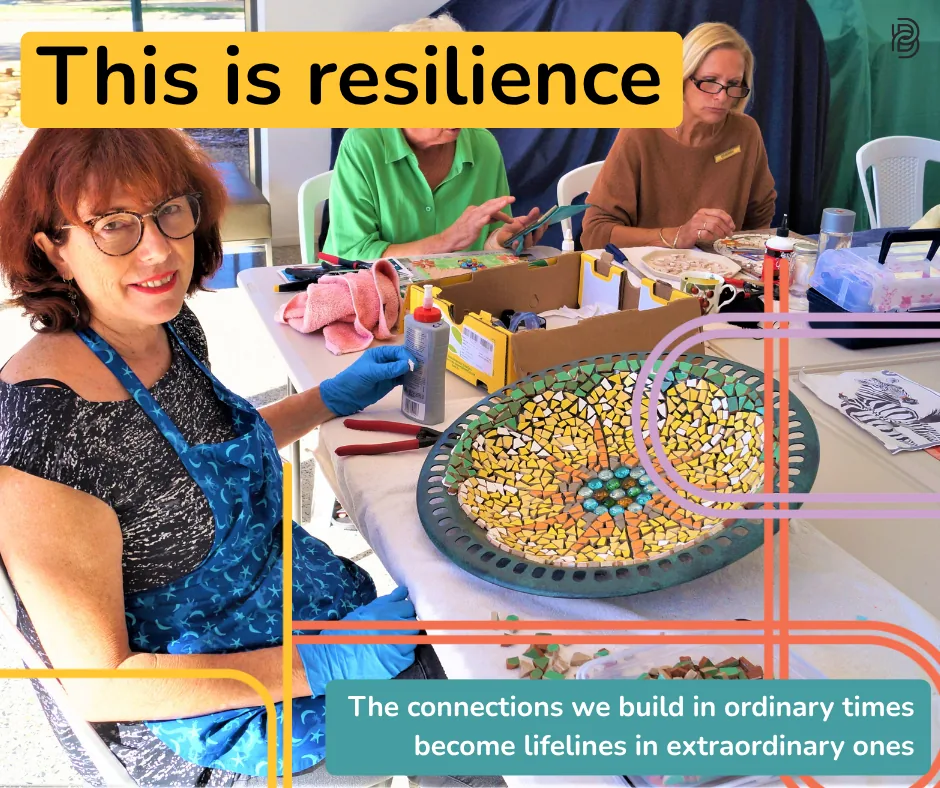
For 16 years, we’ve been developing Befriend, a non-profit community building organisation that’s helping to nurture and grow more inclusive, connected communities (or, to put it a little more poetically, we’re helping to tend to the soil from which friendships grow). Since our earliest days, our organisation has held a deep understanding and appreciation for the power of friendship in living a good life—It is our friendships that bring meaning and joy, a sense of purpose, improved physical and mental health and longevity, self-worth and personal confidence, feelings of inclusion and belonging—and for our communities, our friendships grow into networks of relationships that increase our sense of safety and security, nurture our care and compassion for one another, and create vibrancy in the shared experiences of community life.
Over time, as we’ve gone deeper into our community building work, we’ve been hearing more and more about how people’s newly formed friendships and relationships are creating value far beyond joyful companionship. We’ve been hearing that these relationships are acting as a vital source of mutual support—people helping each other in daily life through small acts of assistance, sharing information & advice, and providing practical and emotional support through tough times. And this grows beyond the 1:1 level—the social groups that have formed through our community building networks are acting as a context for people to self-organise, rally as a group, and leverage broader support through their extended social networks in the face of personal and community challenges.
These relationships of mutual care and support are vital for all of us, but particularly so for people who experience vulnerabilities associated with age, disability, health, isolation, financial stress, housing insecurity, parenting strain, separation, grief and loss, redundancy, migration, social exclusion, and other circumstances. For many individuals and families, it is the freely-given friendship of others that is the most vital lifeline, offering us safety, shelter and security, practical and emotional support, kind companionship, affirmations of our worth and dignity, and a sense of hope. While vulnerability certainly isn’t evenly distributed, it’s easy to forget that we all experience vulnerability in different ways, shapes and forms, at different times throughout our lives. Ultimately, we all need each other.
Perhaps one of the greatest shared vulnerabilities we all face today is our changing climate. Significant climate-related events like bushfires are increasing in their frequency and severity, locally and globally. There is a growing body of international evidence that demonstrates that our organisation’s perspectives on the importance of community connectedness for resilience is far more than local and anecdotal. World-renowned research by Daniel Aldrich and others is now creating a compelling case for governments and communities to see ‘social capital’ as a vital part of the disaster resilience investment picture. Aldrich’s research in disaster-affected communities across the USA, Japan, India, Thailand, New Zealand and West Africa is showing that the strength of connections within a community is critical for the community’s collective capacity to respond, adapt and recover in the face of significant disasters.
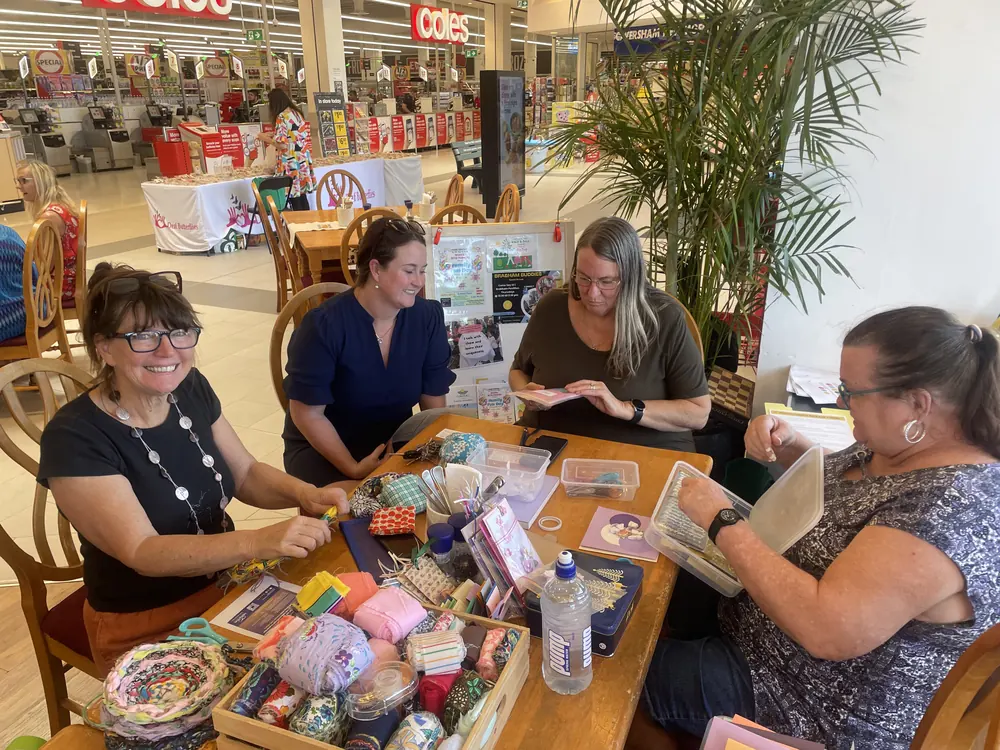
What is often missing from the conversation about disaster resilience is some explicit acknowledgement that humans have directly contributed to the mess we’re in, through the many complex and interwoven choices that we’ve built our society on. Beyond disaster risk mitigation and adaptation to the current/emerging context, we also need to be finding ways to transform our current ways of living, breaking the cycles that are perpetuating and accelerating our current suffering. As Nora Bateson explains, submergence precedes emergence, so how might we tend to our submerging future? These possibilities will depend on our capacity to work together, to trust in one another, listen deeply, acknowledge our part in this mess, shift our perceptions, dream wildly, experiment creatively, act boldly, organise, and reshape life as we know it, together.
Maybe a craft group isn’t the craziest place to begin, after all.
This blog is the first in a series entitled “This is Resilience”, where we explore the themes from our community research focused on resilience and how the connections we build in ordinary times can become lifelines in extraordinary ones.
With thanks to the Department of Fire and Emergency Services for their support in bringing this project to life.
Related articles
Looking after each other
When does a friendly face become someone you can count on? Community members share how practical help and being able…
View this resource
The art of giving and receiving
Are you always the helper? Mutual support means letting others care for you too. We explore why receiving help matters…
View this resource 
The power of a warm welcome
Walking into a new group can be nerve-racking. Community members told us how small gestures of welcome helped them come…
View this resource 
Little offers make a big difference
Good things often start with a small offer: a hand with something, an invitation, a skill shared. We look at…
View this resource 
Gift Discovery and deep listening: what happens when a team really listens to each other
Before a team of student consultants got stuck into their work for Befriend, Dave and Elaine gave them a taste…
View this resource 
Befriend wins the 2026 WA Inclusive Volunteering Award
We are absolutely over the moon to share that Befriend has been named the winner of the Inclusive Volunteering Award…
View this resource 
Helping Others Feel More Connected
Supporting someone to feel more connected means creating the right conditions for friendships to grow. By focusing on shared interests,…
View this resource 
Give the gift of connection this Christmas!
Human connection is the best gift of all. We tend to think of the festive season as a busy time…
View this resource 
"I Like People!"
Tim’s story shows how connection grows through purpose, creativity, and contribution. Living with expressive aphasia and using a wheelchair, he…
View this resource 
Nurturing your own community idea to life
Nurturing a new community idea to life can feel like stepping into the unknown – exciting and a little intimidating!
View this resource 
The Empathy Effect: sparking friendships through the art of understanding each other!
Empathy is a powerful way to build connection and friendship, even with strangers. By showing curiosity, listening deeply, and keeping…
View this resource 
Give it a Go in Swan
Give it a Go is a fun, free travelling community adventure happening across different locations in the City of Swan!…
View this resource 
Open Communities - coming together in learning
Open Communities invites community builders, volunteers and organisations to co-design a shared learning space for connection and collaboration. Through gatherings,…
View this resource 
Feeling awkward about meeting new people? It's totally natural!
Do you often find yourself saying “I’d like to go… but I don’t really know anyone and it might be…
View this resource 
Supporting Community: A Network Development Project in the City of Kwinana
We are a non-profit social enterprise based in Perth, Western Australia who exist for one single purpose; to foster inclusive,…
View this resource 
How do I make friends in Perth if I’m introverted?
You want to meet people, form friendships and feel less alone, but you think that your introverted nature is an…
View this resource 
Creating a friendship that lasts
Do you find that even if you chat with new people while out and about, these interactions don’t lead to…
View this resource Everyday connectors
COVID-19 was a strange time. It was a unique moment in history where we bunkered down safely at home wherever…
View this resource Want to keep up to date?
Be the first to hear about catch ups, seminars and other events by subscribing to our mailing list.
By submitting your information you agree to our Terms & Conditions and Privacy Policy.
By submitting your information you agree to our Terms & Conditions and Privacy Policy.